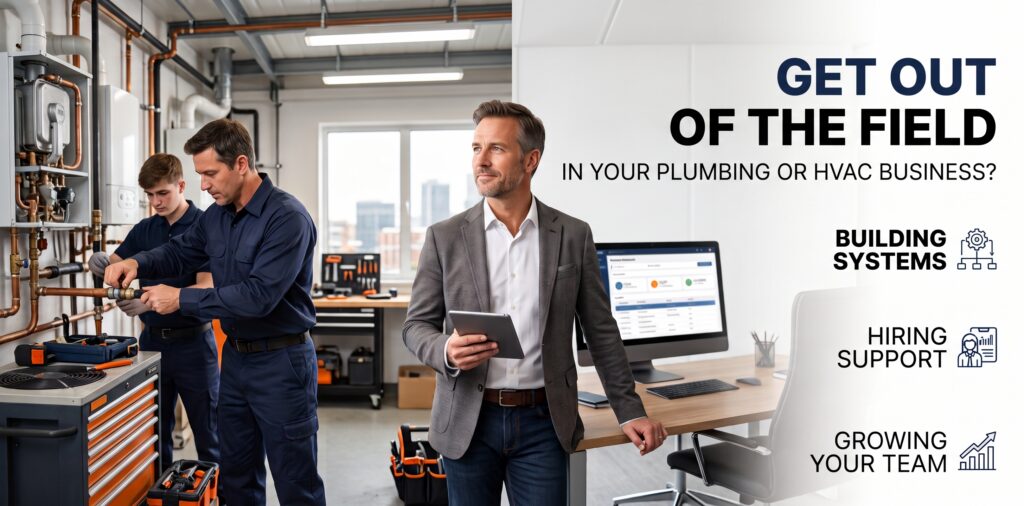
How to Get Out of the Field in Your Plumbing or HVAC Business
Learn how service contractors step away from daily truck runs by hiring support around bottlenecks, building clear systems, and coaching a reliable team.
You get out of the field by building a plumbing or HVAC company that operates without your constant physical involvement. Stepping away from daily service calls requires hiring office or field support, documenting standard operating procedures, and allowing employees to make decisions through experience rather than relying on you for every answer.
The 4 Stages of Leaving the Field
| Stage | Operational Focus | Primary Goal |
|---|---|---|
| 1. Owner-Operator | Owner handles calls, installs, billing, and scheduling. | Establish initial cash flow and client trust. |
| 2. Supported Tech | Office support and field helpers absorb daily tasks. | Remove phone distractions while on job sites. |
| 3. Operations-Led | Managers, lead techs, and written SOPs handle routes. | Step off the service truck permanently. |
| 4. Business Leader | Owner focuses on strategy, hiring, and marketing. | Scale company value and long-term equity. |
Why Contractors Get Trapped Running Service Calls
Most plumbing and HVAC businesses stay trapped in the field because operations depend entirely on the owner's personal technical skills. When every estimate, schedule change, customer concern, or technical question requires your input, you own a job with employees attached rather than a scalable business.
Starting a trade company usually means running calls, answering phones, and doing paperwork yourself. While that hands-on hustle works early on, business growth eventually creates a hard ceiling. You become the lead technician, dispatcher, sales manager, and customer service department all at once.
At that point, your company cannot grow beyond your personal physical capacity. Reaching the next level of revenue requires moving away from manual labor and building operational support around yourself.
Target Your Primary Bottleneck First
Hire additional field technicians or apprentices to increase production capacity.
Hire customer service support to handle bookings so you stop answering calls on jobs.
Hire a service manager or field supervisor to oversee daily job site operations.
Why Systems and SOPs Are Necessary for Delegation
Standard operating procedures (SOPs) provide documented guidelines that explain how your company handles recurring situations. Written systems allow team members to solve daily problems consistently without interrupting you for permission.
Hiring employees without creating written standards simply shifts the workload without solving the underlying problem. Without documented rules, team members will call you constantly to ask basic questions, making you the main operational bottleneck once again.
Greeting scripts, emergency screening questions, and appointment booking steps.
How jobs are assigned to technicians based on skill level and service area.
Flat-rate pricing sheets and structured follow-up routines for open job quotes.
Shifting From Controlling to Coaching Your Team
Coaching your team means setting operational standards, reviewing job outcomes, and helping technicians improve through experience. Controlling behavior involves approving every decision, jumping into minor issues, and preventing your team from learning.
Many trade owners struggle to step away because letting go feels risky. Thinking that nobody else can do the job right keeps you stuck in a service truck. Employees need room to solve problems, make minor mistakes, and learn through repetition.
Preventing every mistake personally prevents your employees from developing confidence. Strong trade companies are built by coaching technicians and office staff to take ownership of their roles over time.
Practical Steps to Transition Out of the Field Faster
Transitioning out of the field requires building clear communication channels, tracking performance metrics, and standardizing the customer experience. Focusing on these operational shifts reduces owner dependency and keeps dispatch boards full.
- Track Accountability Metrics: Monitor call booking rates, average ticket size, technician revenue, and customer review scores to make data-driven decisions.
- Standardize Customer Interactions: Ensure every phone call, scheduling notice, and job site visit follows identical service standards.
- Develop Internal Field Leaders: Train senior technicians to handle complex field diagnostics and coach younger apprentices on site.
Frequently Asked Questions
When should a plumbing or HVAC owner stop running service calls?
An owner should stop running service calls when physical labor prevents them from handling strategic growth, customer service management, hiring, and financial oversight.
What role should a trade contractor hire first to leave the field?
The first hire depends on your biggest operational bottleneck. If you are buried in job site work, hire field technicians. If phone calls and scheduling interrupt your work, hire customer service support.
Why are standard operating procedures (SOPs) necessary for trades businesses?
Standard operating procedures provide clear, written rules for recurring tasks, allowing employees to solve daily problems independently without calling the owner for permission.
Remove Phone Distractions and Step Out of the Field
You cannot scale your business if ringing phones constantly pull you away from managing operations. Let professional operators answer your calls 24/7 with Jill's Office.
Book your discovery call today